Showing posts with label Harry Potter. Show all posts

Sunday, December 31, 2017

The Power of "The Buzz!"


Readers Workshop has been on my mind lately.  MY Reader's Workshop in particular. 

I'm thinking about the tools in MY arsenal...forms (both digital and paper), my GINORMOUS BINDER OF READERS, my "Conferring Apron," the fancy pens, my notebook, the numerous anchor charts plastered to my walls...just thinking about all of this makes my head want to explode!

Seriously.

But the best tools that I bring to my Reader's Workshop are the strategies I share with readers and the TEACHER'S MOVES that I use to build excitement around reading because, let's face it, without student engagement, you've got nothing.  

This I know.

My well-worn copy of The Book Whisperer reminds me of the importance of passing my love of reading on to my students through my own personal enthusiasm about books and the magic that lies within them. 

One of the most powerful Teacher Moves that I can possibly use to build excitement amongst my fourth grade readers is THE BOOK BUZZ.  

This is one of those Teacher Moves that is so subtle at first but then snowballs into something that can really take on a life of its own in relatively quick fashion.  

Don't believe me?  Consider the hype that surrounded the Harry Potter books...or the excitement that Scholastic builds around its release of the newest Diary of a Wimpy Kid book...the energy that builds around reading takes on a life of its own.  And "kid readers" fuel the fire!

So my question here is this:  Why aren't we harnessing "The Power of the Book Buzz" more often in our own classrooms?  

Here's a universal truth...If you "hype" a book with your readers and create THE BOOK BUZZ, you can create a book frenzy right in your own classroom.

Every time I read a book that I'm about to add to my classroom library, I share it as part of the day's mini-lesson.  Inevitably, there's at least one student who wants to read the book before I shelve it.  So the book is immediately passed on to the reader.  There's always a kid who pipes up, "Can I have it after you finish it?"  Here's where I post a Sticky Note to the back of the book and have students who wish to "have a kick at the cat" sign their names to the book.  Now the book has a road map of where it's headed.

Over the summer, I picked up this sweet little read:


Elise Gravel's book is an interesting mix of sketches and creative writing, all rolled up into a neat little notebook package.  I had fun picking through it, and I thought that my fourthies would enjoy her quirky sketches and amazing sense of humor.


I started by sharing this book during a minilesson about keeping a Reader's and Writer's Notebook.  This is actually a fabulous example of what a notebook full of ideas could become!

My readers were intrigued.  Fascinated.  Enchanted.  

Frenzied hands reached out for this book.  Readers jostled one other as they reached out to put their names on the back of this book.

I intended to put If Found Please Return to Elise Gravel in my "book gutter."  So far, this book only makes it's way back to the gutter at the end of the day.  It is the first book grabbed in the morning and it is passed about so often, I know that I'm going to need to replace it sooner or later.

If there is a cluster of students around a table, it is usually because groups of them are marveling at the illustrations or laughing at the notes that accompany them.

Taking a nod from Donalyn Miller, I have incorporated the "40 Book Challenge" into Reader's Workshop.  To add a little excitement to this challenge, I reached out to a few different authors to ask if they could help me out by contributing a signed book to our competition.

The first author I reached out to was Elise Gravel...who is amazingly awesome by the way.  She responded to my request within minutes and sent this my way:
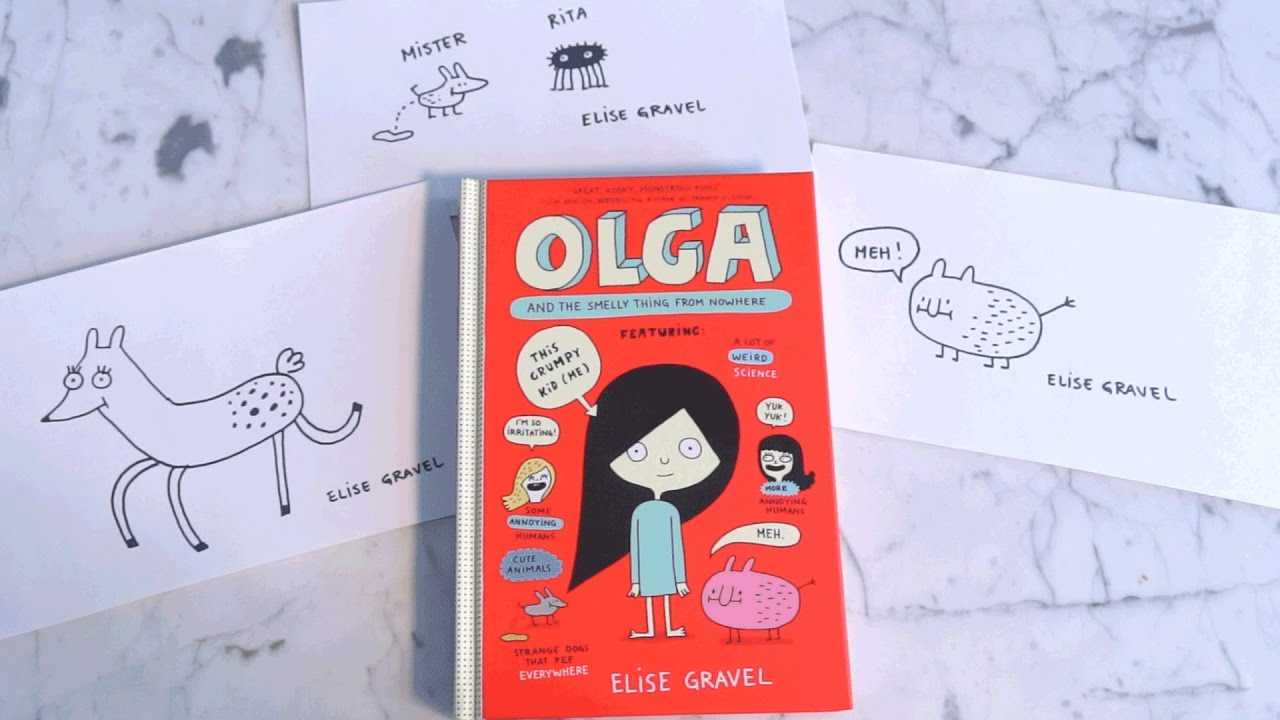


Oh yeah...Elise Gravel rocks our world.  This book has been situated in a place of honor, just waiting for the first round of 40 Book Challenge qualifiers to add their names to the drawing.  There's so much excitement built around Olga and the Smelly Thing From Nowhere...my kiddos just walk up to it and gaze adoringly at the book with its unknown treasures inside (including a great autograph and personalized note from Elise!)...sigh.

So...if you aren't creating a Book Buzz in your classroom, why aren't you?  If you are looking for 3 reasons, here they are (in no particular order):

  1. Book Buzz costs you nothing but 5 minutes of class time to get the whole conversation started...so it's economical.
  2. Book Buzz gets real kids excited about reading.  (John Hattie ranks Student Engagement super-high his work, Visible Learning!)
  3. Book Buzz allows you to put HIGH QUALITY literature into the hands of students without them even realizing it!  (Kind of like sneaking cauliflower into a tub of mashed potatoes!)  Jack Gantos' book, Dead End in Norvelt is a fabulous book that consistently is checked out more than any other book in my classroom.  Why?  Because I created a Book Buzz with the book.  It's an awesome Newberry Award Winner that is so well-crafted and enormously funny...but it competes for shelf space with lesser quality books.  Kids need to know about books like this.  It's up to us to share them...often!


Never underestimate "The Power of The Buzz!"  


Wednesday, March 22, 2017

The Reading Strategies Book Goal 6: Supporting Comprehension in Fiction (Thinking About Characters)


Ooooh!  Oooh!  Is it my turn yet?  

Hooray!  I'm so excited to be joining a talented team of educator bloggers in this great conversation about THE BEST READING RESOURCE on the planet!  


Recognize this guy?  Recently, my 4th grade students and their 1st grade Book Buddies were sharing some of their favorite books, and Clifford the Big Red Dog was the topic of conversation amongst all of the readers.  

If you think that getting to know the characters in the book you are reading doesn't matter...think again.  My 4th graders reminisced with great fondness the adventures that Clifford and Emily Elizabeth had together...just like you'd remember the exploits you had with your very best friends.

That's why the reading work outlined in Goal 6 is important work...understanding the characters and how they feel...what makes them tick...feeling empathy towards their situations...these all converge together to not only engage the reader, but to enhance their understanding of the text.


So then there's this guy, Greg Heffley, and by the time my students begin their work with me in the 4th grade, they begin to put character traits together to name a theory about the character.  One of my students recently shared with me this little nugget of wisdom..."Greg is pretty much all about himself.  He doesn't know how to be a good friend to Rowley, and part of that is because you've got a lot to live up to in order to even be half as good as he is!"  Interesting insight from a nine-year-old!


As our readers become more fluent and more sophisticated in their choice of texts, secondary characters come into play...and their storylines become much more important.  Case in point...as Harry Potter, Ron Weasley, and Hermione Granger all advance through Hogwarts, the layers that Ron and Hermione lend to Harry's story help to shape the character he ultimately becomes.  Harry's dedication to his friends plays an important role in his decision-making process.

Goal 6 offers 24 fantabulous "Thinking About Characters" strategies.  My three favorites, in no particular order, are:

6.1:  How's the Character Feeling?  

Jennifer reminds us of the importance of knowing our characters, and caring about how these characters feel.  Empathizing with our characters helps us as readers connect deeply and personally.

When readers pay attention to the characters in their story, they notice how the character acts, how the character speaks, what the character says, and what the character thinks.  

What do these things tell the reader about how the character is feeling?  Is a feeling like this positive or negative?  What leads you to think this way?

This strategy, while straightforward, has so much to offer readers at ALL levels.  Early/Emergent readers can use cues in the illustrations to help them understand what the character is feeling.  More fluent readers should be encouraged to "mine" their texts for clues as to what the character is feeling (dialogue, punctuation, body language, etc.).

6.3:  Put on the Character's Face  


I love how Jennifer talks about the idea of "putting yourself in the character's shoes."  She shares how kids take that phrase so literally, and how the wording can really get in the way.  She asks us to reconsider this language and urge students to "try to feel what the character's feeling."  Why not "try on the character's face?"  How are they feeling?  What does disappointment look like on your face? Can you see disappointment in your body language?  

I absolutely adore the anchor chart featured in this strategy!  An excellent extension would be to have students create an anchor chart that features photos of your readers and the many emotions they show!

6.17:  Talk and Actions as Windows  

This strategy makes use of "dialogue tags" to infer what kind of person the character is.  When we notice not just "what the character says," but "how they say it," we gain a better understanding of what kind of person the character is.

This also applies to the character's actions, because, as we know, we can "read" a character based on what they do!

This strategy has a great little visual that involves a window with curtains.  This would make an awesome anchor chart or a great addition to an interactive Reader's Notebook!

I'd love to hear what's working for you when you and your students "Think About Characters."  Are there any takeaways from Goal 6 that you are just itching to try out?  Please check in and share in the comments section...each conversation is important and helps us all to grow our thinking!

With a nod towards Theresa's blog entry at Tried and True, I echo the sentiment that our teacher bloggers who have contributed to this book study have completed and shared important work that benefits and elevates all educators.  If you haven't visited these entries, what are you waiting for? 


Thanks for stopping by!

Nikki